
Thank you to Authority Magazine and Jilea Hemmings for interviewing Dr. Carl Law, founder of Doctors First Staffing, in your article: “Inspirational Black Men and Women in Medicine: 5 Things You Need To Create A Successful Career In Medicine
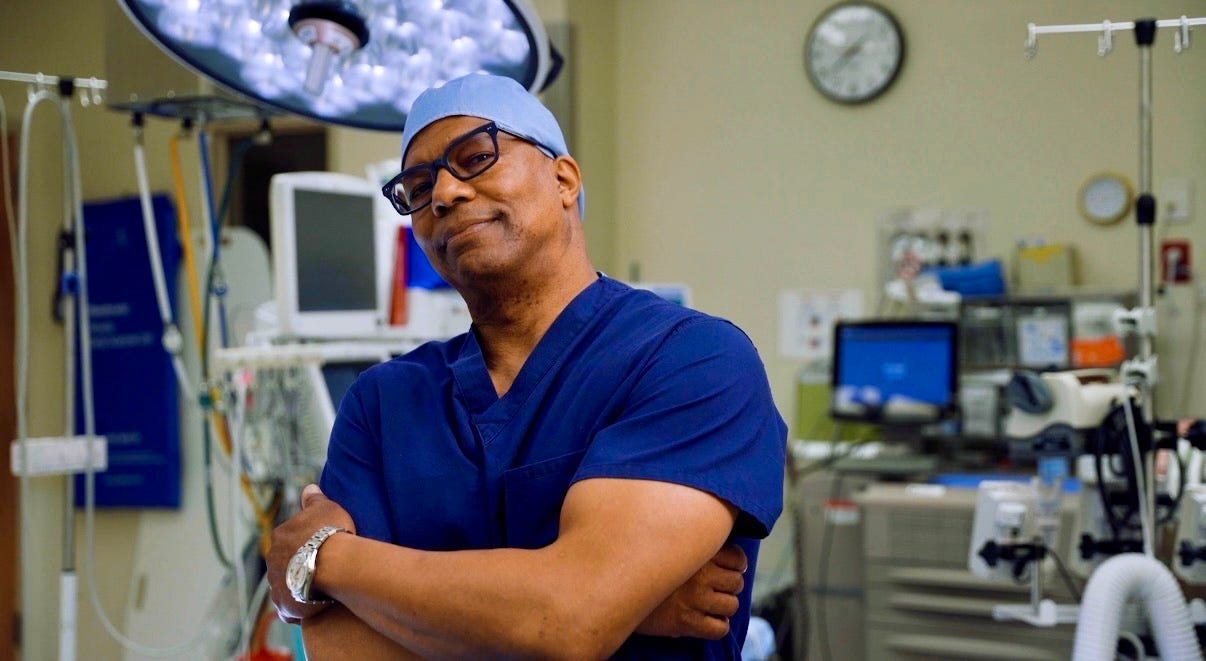
Representation isn’t symbolic. It changes trust. It changes outcomes. And that is why I’m here.
In the United States today, black doctors are vastly underrepresented. Only 5% of physicians nationwide are black. Why is it so important to have better representation? What steps can be taken to fix this discrepancy? In this interview series, we are talking to successful black men and women in medicine about their career, their accomplishments, and how others may follow their path.
As a part of this series, we had the pleasure to interview Carl Law.
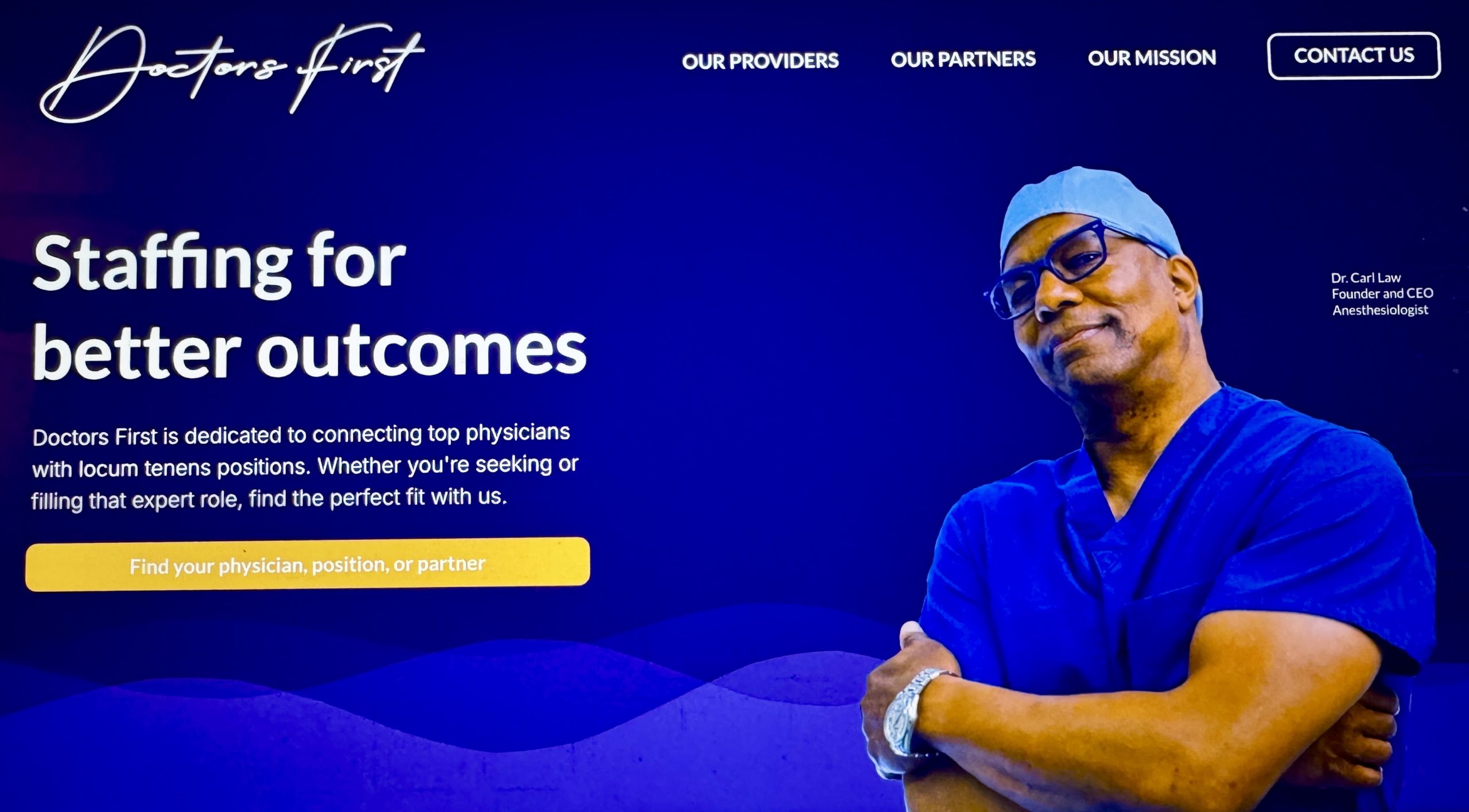
Dr. Carl Law is a board-certified anesthesiologist with over 35 years of clinical leadership experience and the Founder of Doctors First Staffing, a physician-owned medical staffing company focused on delivering consistent, high-quality care. He trained at the University of Pennsylvania and completed a Pain Management fellowship at Stanford University before building a career leading anesthesia departments across major hospital systems in California. As both a physician and a person living with diabetes, Dr. Law advocates for patient-centered care, physician well-being, and strengthening representation and mentorship for Black medical professionals.
Thank you so much for doing this with us! Before we dig in, our readers would like to get to know you a bit more. Can you tell us a bit about your childhood “backstory”?
I was born and raised in Pennsylvania in a family that valued education, resilience, and community. My parents were hardworking, and lived with hypertension and diabetes for most of their adult lives. I saw firsthand how chronic illness affects not only the body, but the entire family. Watching them navigate the healthcare system shaped my belief in compassionate, consistent, and dignified care. This and my amazing pediatrician, Dr Richard Paul, ultimately led me to medicine.
I was the kid who loved science, but I also spent as much time as I could outside. Surfing would become a big part of my life later on, but even as a teenager, the water was where I felt steady and present. I carried that sense of balance with me through college at University of Pennsylvania, medical school at Penn State, residency at the University of Pennsylvania, and my fellowship at Stanford.
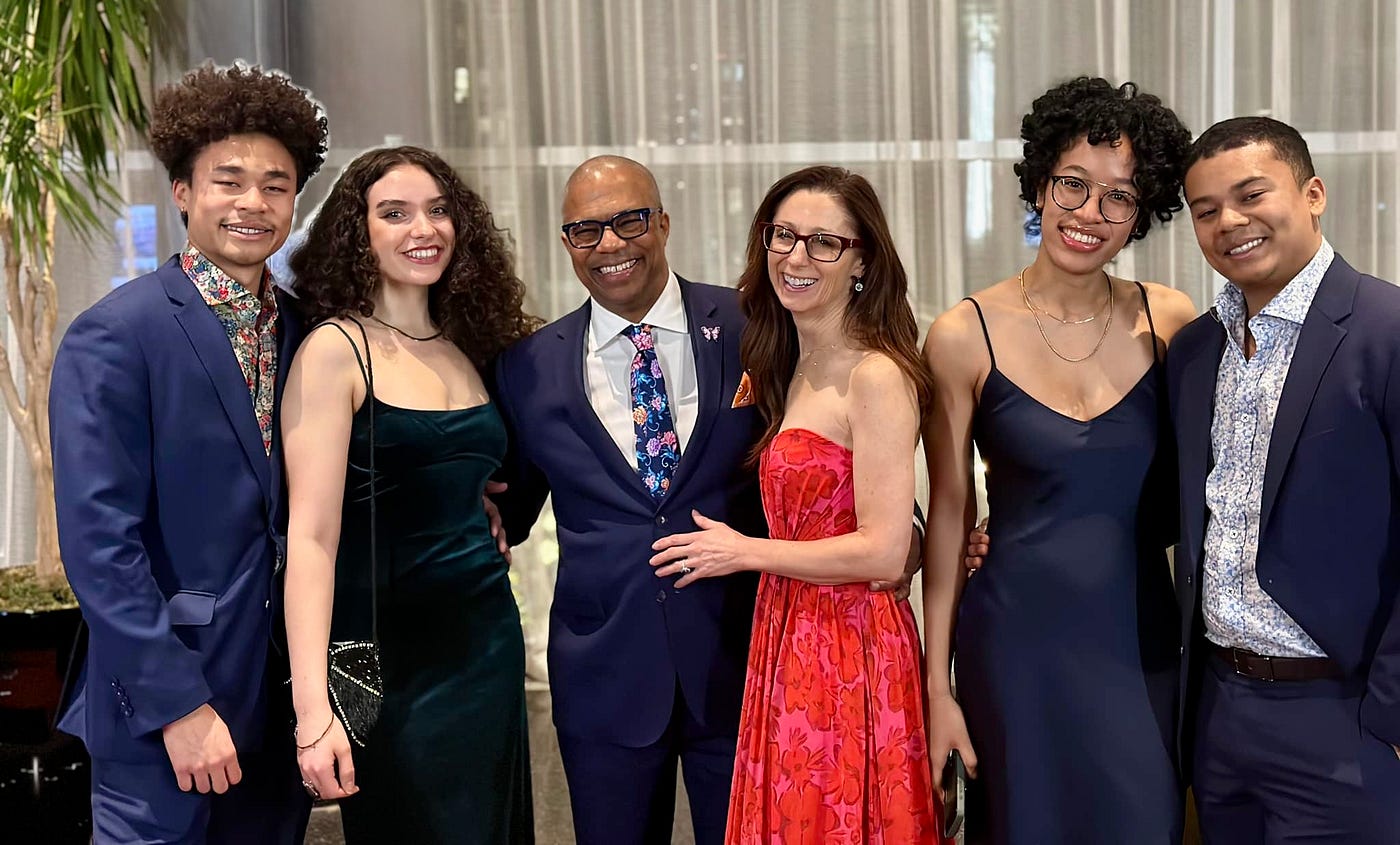
I’m also a father. I raised two sons who are now college graduates, and I’m helping my fiancée’s daughter learn to drive, grow her confidence, and navigate life as a young woman. Being a dad has shaped me just as much as being a physician. The lessons overlap: show up, be accountable, lead with integrity, and know when to listen. Those values are what guided me into leadership roles in hospitals, and eventually, into founding Doctors First Staffing, because I believe physicians care best when we are supported as whole people.
Can you tell us a story about what brought you to this specific career path?
The moment I knew I was meant to become a physician wasn’t dramatic — it was a slow accumulation of experiences. Growing up, I watched my parents live with diabetes and high blood pressure, and I saw the way medical care was delivered to him. There were brilliant physicians who helped him, and there were others who were rushed, distant, or did not communicate in a way our family could understand. I remember thinking, even as a teenager: If someone had just taken a few more minutes to connect with him, maybe things would have been different.
When I walked into hospitals, I rarely saw Black physicians and even today I still don’t. I didn’t see myself reflected in the people making the decisions. I didn’t see my community represented in leadership. And I felt that absence. It’s hard to become what you don’t see, but sometimes that becomes the reason you do it.
In medical school, that understanding became a purpose: I wanted to be the doctor who listened, who explained, who met patients as whole people. I also wanted Black patients to walk into a room and see someone who understood them before a single word was spoken.
That commitment has guided every chapter of my career, from clinical care, to leadership, to founding Doctors First Staffing. Representation isn’t symbolic. It changes trust. It changes outcomes. And that is why I’m here.
Can you please give us your favorite “Life Lesson Quote”? Can you share how that was relevant to you in your life?
One of my favorite life lessons is something simple: “Move with intention, not urgency.”
In medicine, and in life, we are trained to move fast. Fast decisions, fast responses, fast outcomes. But urgency can cause us to react instead of lead. Early in my career, I learned that the most effective physicians are not the ones who move the fastest, but the ones who remain centered, observant, and intentional, especially in high-stakes environments like the OR.
This lesson became personal when I was navigating my father’s health challenges, raising two sons on my own, and later managing my own diabetes diagnosis. I learned that if you live only in urgency, you burn out, emotionally, physically, spiritually. But when you move with intention, you make space for clarity, compassion, and connection.
That mindset has shaped how I practice medicine, how I lead teams, and why I founded Doctors First Staffing. We aren’t just filling shifts, we’re building relationships that are sustainable, respectful, and aligned. Intention creates better patient care, stronger physician support, and healthier outcomes for everyone involved.
Can you share the most interesting story that happened to you since I began your career?
One of the moments that stayed with me didn’t happen during a dramatic case, ironically, since my patients are usually unconscious, it happened in a quiet conversation. During my first year of residency, I cared for a patient who was anxious about surgery. Not unusual, but when I sat down and really talked with him, he told me he had lost trust in the medical system. He didn’t feel seen, heard, or understood. What surprised me was not what he said, but the way he said it. He relaxed the moment he saw me walk in. He said, “I feel like you understand me before we even start talking.”
That moment wasn’t about technique or science, it was about presence, representation, and cultural connection.
Years later, when I began doing locum tenens work, I saw how physicians were also feeling unseen. Talented, dedicated doctors were being treated as interchangeable, not as people who build trust with patients and teams. I realized the problem was systemic: both patients and physicians need to feel valued.
That conversation, and many like it, is what led me to found Doctors First Staffing, a company built on relationships, continuity, and humanity. We remember that medicine is personal, and when you honor that, everything else improves.
You are a successful leader. Which three-character traits do you think were most instrumental to your success? Can you please share a story or example for each?
- Steadiness under pressure. In the operating room, emotions can run high and decisions must be made clearly. During my residency, my mentor Dr Frank Murphy taught me, that the operating room team takes its cues from the anesthesiologist — if I am calm, everyone else settles. Over time, that steadiness became my leadership style. Whether it’s a complex case, a staffing crisis, or a business decision, I focus on grounded clarity. I’ve learned that people don’t need you to be perfect, they need you to be present.
- Listening before leading. When I became Facility Medical Director, I spent my first few weeks not making changes — but listening. I asked nurses, CRNAs, surgeons, and techs how the workflow actually felt day to day. The solutions to the problems we were facing didn’t come from a memo; they came from the people doing the work. Listening builds trust, and trust makes leadership possible.
- Doing the right thing, even when no one is watching. The decision to found Doctors First Staffing came from that principle. I saw physicians burning out and hospitals struggling, and I knew we could do better. Creating a company “by a physician, for physicians” wasn’t the easiest path — but it was the right one. When values drive decisions, the rest follows: quality improves, relationships deepen, and outcomes are better.
Thank you for all that. Let’s now shift to the main focus of our interview. This might seem intuitive to you, but it would be helpful to articulate this expressly. Can you share three reasons with our readers why it’s really important for there to be more diversity in medicine?
- Diverse teams provide better patient care — and better outcomes. When patients see themselves reflected in their caregivers; trust is built more quickly. That trust translates into better communication, better adherence to care plans, and ultimately, better outcomes. It is not simply representation for the sake of representation — it is a medical necessity. Patients deserve care providers who understand the cultural, social, and historical context of their lives.
- Diversity in medicine challenges bias — both conscious and unconscious. We know that medical bias exists: from pain assessment to diagnosis patterns, data confirms disparities. Increasing diversity in the profession introduces more perspectives at the decision-making table. It allows us to question inherited systems, bring forward new research priorities, and train future doctors to recognize — and interrupt — bias rather than perpetuate it.
- Representation strengthens communities — and inspires the next generation. When a child sees a physician who shares their background, something fundamental shifts: what once felt improbable becomes achievable. Representation isn’t just about who is practicing today — it is about who believes they can practice tomorrow. Each of us is part of building that pipeline.
As things stand today, what are the main barriers for black men and women to enter the medical field?
There are several barriers that continue to make the road to medicine harder for Black men and women, and none of them reflect a lack of talent or desire. One of the earliest barriers is access. Too often, students in under-resourced communities attend schools without robust science programs, mentorship, or exposure to healthcare careers. You can’t pursue what you’ve never been shown is possible.
Then, there’s the financial burden. Medical education is long and expensive. Many Black students are the first in their family to attend college, and the thought of accumulating six-figure debt before earning a paycheck can feel overwhelming. Even getting to medical school requires costly exam prep, application fees, and unpaid clinical experiences.
Finally, there is a cultural and emotional barrier — the weight of being “the only one” in a space. When you rarely see physicians who look like you, the journey can feel isolating. There are subtle messages, spoken and unspoken, that can make you question whether you belong.
These barriers are structural, not individual. And that means the solutions must be structural too — mentorship pipelines, financial support, inclusive academic cultures, and intentional recruitment and retention efforts at every level.
From your perspective, can you share a few things that can be done by the community, society, or the government, to help remove those barriers?
There are absolutely steps we can take to remove these barriers, but they require collaboration across communities, institutions, and policy.
First, we need to start early. Communities and school districts can partner with hospitals and healthcare organizations to create mentorship and exposure programs beginning in middle and high school. When young people see physicians who look like them and have opportunities to shadow or volunteer, it changes what they believe is possible.
Second, we must address the financial hurdle. Government and healthcare systems can expand scholarships, loan forgiveness, and paid clinical training pathways — especially in underserved areas. Choosing to serve your community shouldn’t come at the cost of your financial stability.
Third, institutions must cultivate environments where Black medical students and professionals feel supported, not isolated. That means leadership diversity, strong mentorship networks, and real accountability for equity in hiring and promotions.
Finally, the broader community has a role — celebrating and elevating Black physicians, supporting health education in neighborhoods, and encouraging young people who show interest in science or caregiving.
We remove barriers when we replace isolation with access, representation, and real support. It’s not just about opening the door — it’s about making sure people feel welcome walking through it.
What are your “5 things I wish someone told me when I first started my career in medicine,” and why? Please share a story or example for each.
1. Medicine is about listening more than speaking.
When I first started, I thought being a doctor meant having all the answers. Over time, I learned that the most accurate diagnoses often come from simply listening to a patient’s story. I had a patient who had several relatives die during or shortly after surgery. While there were no medical records with explanations, based upon her story I believed that she was at risk for malignant hyperthermia. I tailored my anesthetic plan to avoid malignant hyperthermia triggers, and she got through with flying colors.
2. Take care of your own health first.
Doctors are famous for telling others to rest, hydrate, move, and manage stress — while doing none of it ourselves. I learned this the hard way through my own diabetes journey. I had to make myself a priority, not an afterthought, and that shift made me a better physician, father, and partner. You cannot pour from an empty cup.
3. Your career will evolve — let it.
I started as a clinical anesthesiologist. Later, I became a physician leader. Now, I’m building Doctors First Staffing. Each chapter required me to release who I thought I was to grow into who I could be. Medicine is not one road; it’s a lifelong path of adaptation.
4. Relationships matter as much as skill.
You can be the most clinically brilliant doctor in the room, but if you cannot communicate, collaborate, and lead, your impact will be limited. The trust I built with colleagues and patients has opened more doors than any title ever has. Kindness and consistency travel far.
5. Don’t forget who you are outside of medicine.
There was a time when I let my identity become only “Dr. Law.” As I grew — and especially as I raised my two sons and now help guide my fiancée’s daughter through her first driving lessons and first heartbreaks — I realized that being a father, a partner, and a person is not separate from being a doctor. It’s the part that keeps you human, grounded, and able to show up for others with compassion.
You are a person of enormous influence. If you could inspire a movement that would bring the most amount of good to the most amount of people, what would that be? You never know what your idea can trigger. 🙂
If I could inspire a movement, it would be something I call “Healthcare Belongs to All of Us.” At its core, it means making the healthcare system feel human again — accessible, respectful, and rooted in community. I’ve spent decades in medicine, and I’ve seen people walk into offices and hospitals feeling intimidated, unheard, or unseen. I’ve seen how a lack of representation, resources, or trust can stop someone from seeking care until it’s too late.
This movement would focus on three simple but powerful shifts:
- Health education in everyday language, not medical jargon.
- Care delivered with dignity, where patients feel like partners and not problems.
- Mentorship pipelines, especially for young Black men and women who don’t often see themselves reflected in the field.
I believe healing happens when people feel safe talking about their health — physical, emotional, and mental. If we build healthcare into community spaces — barbershops, schools, churches, beaches, basketball courts — we can change outcomes without waiting for the system to catch up.
If one person feels seen, heard, and valued — they are more likely to care for themselves. And that ripple can change families, neighborhoods, and generations.
We are very blessed that some very prominent names in Business, VC funding, Sports, and Entertainment read this column. Is there a person in the world or in the US with whom you would love to have a private breakfast or lunch with, and why? He or she might just see this if we tag them.
If I could sit down for a private meal with anyone, it would be Magic Johnson.
Magic has worn many hats in his lifetime — world-class athlete, entrepreneur, community investor, and someone who has navigated public health with honesty and courage. What inspires me most is how he took adversity and turned it into impact, not just for himself but for entire communities that are often overlooked. He doesn’t just talk about reinvesting in Black neighborhoods — he does it. He builds businesses, he trains leaders, he gives people opportunity with dignity.
As the founder of Doctors First Staffing, I’m working to improve access to high-quality healthcare providers and create pathways for more Black professionals to thrive in medicine. I’d love to talk with him about what it really takes to scale community-centered solutions, to stay grounded while leading, and to build things that last longer than we do.
I believe we share the same belief:
When you invest in people, you’re investing in the future.
If Magic ever sees this — I’d be honored to shake his hand and have that conversation.
How can our readers best continue to follow your work online?
The best way to stay connected with my work is through Doctors First Staffing. You can follow our updates, physician resources, and upcoming community initiatives on LinkedIn at:
LinkedIn (Company): https://www.linkedin.com/company/doctors-first-staffing
LinkedIn (Personal): https://www.linkedin.com/in/nathaniel-carlton-law-md-02362535/
You can also find more about what we’re building — and how to partner with us — at our website:
Instagram: https://www.instagram.com/doctorsfirststaffing/
Facebook: https://www.facebook.com/profile.php?id=61583595728430
Twitter / X: https://x.com/DrFirstStaffing
Tik Tok: https://www.tiktok.com/@doctorsfirststaffing
Youtube: https://www.youtube.com/@DoctorsFirstStaffing
Pinterest: https://www.pinterest.com/doctorsfirststaffing/
Thank you for these fantastic insights. We greatly appreciate the time you spent on this.
Thank you for reading and for being part of this movement to support physicians and build healthier communities.
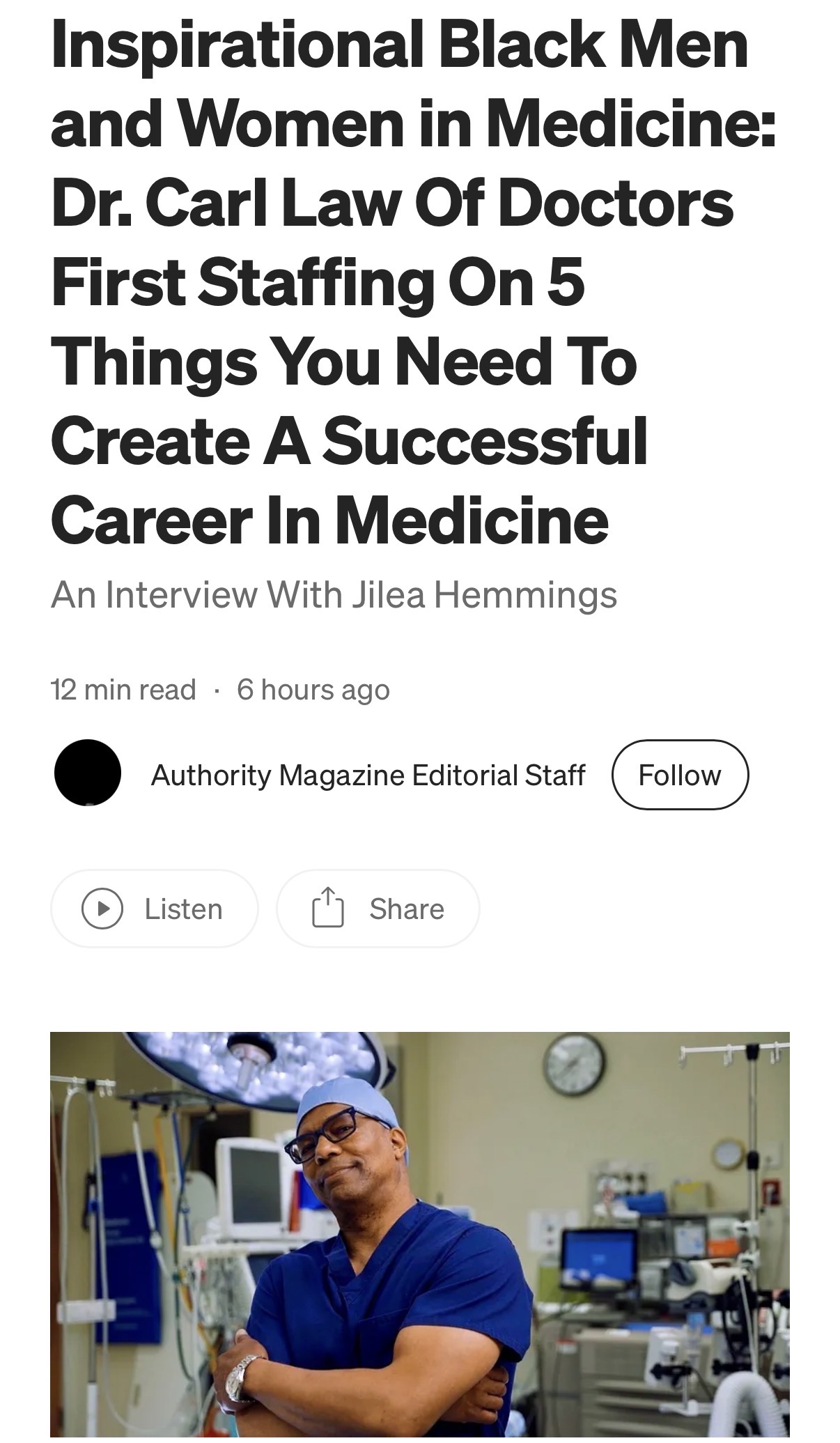
Thank you to Authority Magazine for interviewing Dr. Carl Law, founder of Doctors First Staffing, in your article: “Inspirational Black Men and Women in Medicine: Dr. Carl Law Of Doctors First Staffing On 5 Things You Need To Create A Successful Career In Medicine.”
