
As a reasonable person can imagine, the citizens of Nicaragua became increasingly angry. During our stay in Managua we met a pharmacist who lived above the city in a nice neighborhood, not far from the Intercontinental Hotel made famous by the journalists who covered the civil war. While we ate dinner and looked down at the city, still mostly functioning without electric lights, the pharmacist and her husband – upper middle class folks who one would not normally associate with a radical revolutionary movement, explained that they and their peers planned to take down the government by force. They had weapons and were getting ready to use them. And so they probably did.
We met many other citizens who later became Sandinista fighters. We would talk on street corners, in bars, and in public parks. I threw my support to them, encouraging these simple individuals to take up arms and defeat the rabid dictatorship that had ruined their country.
I have a personal connection to the theft of the aid money. In my hometown of Lennoxville, a local elementary school that many of my friends attended, Ecole St. François, took up donations to send to Nicaragua to help the earthquake victims. The kids raised a few thousand dollars, a lot of money in rural Quebec for grade-schoolers in the 1970s. Some months after forwarding the money directly to the Nicaraguan government, the school asked how the cash had been used to aid the earthquake victims. The hubris of the response was astounding. Not even bothering to make up a plausible alibi, the Nicaraguan embassy in Ottawa told the children that the money, alas, had never reached Managua but had been “lost.”
A German woman I met a few months after the revolution, with whom I became a close friend, was with the revolutionaries who stormed the presidential palace. A picture of her drinking champagne in Somoza’s bathtub was widely disseminated at the time in the international media.
I stayed with her a few years later at her apartment in Berlin. Unfortunately she became increasingly radical herself, to the point where she was reluctant to explore her own city with me, for fear of being perceived as supporting the bourgeois society that she believed Germany had become. I haven’t seen her since 1980.
A lot of time has passed since 1978. The Sandinistas, like so many idealistic movements who have won power in their homelands, were corrupted by their own success and fame. Ronald Reagan decided they were terrorists and funded a long dirty war against them, adding to the endless misery constantly endured by ordinary Nicaraguans. Eventually Managua was partially rebuilt, and I understand that now luxury shopping malls and apartment buildings grace the city outskirts. Even the central district has finally undergone restoration.
But I still wonder if the original refugees have benefited from these changes, or whether they have inherited the same abysmal economic conditions as their parents and grandparents suffered under the Somoza regime.
In 1978 I took many photos of the ruins of Managua. Most have been lost, but a lucky three images have survived the years:
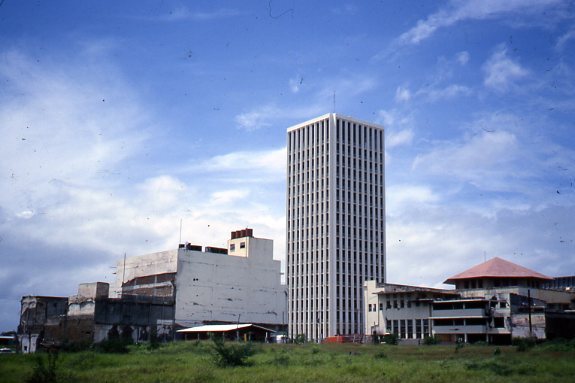
1) The Bank of America building in Managua. Locals told me that all the floors pancaked during the earthquake. Luckily the quake happened at night when few workers would have been inside. The other structures in the photo were uninhabited and dangerous wrecks

2) Managua’s cathedral. Six years after the temblor authorities had yet to authorize workers to sweep the floor clean of debris

3) Inside the ruins of an upper-class establishment, complete with swimming pool

4)On the bright side, the Somoza family still created self-portraits during the waning days of their reign (I shot this photo somewhere en route to the Caribbean coast).

5) Another violent symbol: men clip the wings of a parrot, just as the government cut off the rights of their people (shot from the balcony of a simple hotel room in Bluefields)
Hi Kit. I was in Nicaragua in 1985. There were still ruins there then. One was the art gallery but the doorways from room to room were a bit like cave entrances…like, a grenade blew the the doorways apart. But I have to say, it established exactly the right atmosphere to view the paintings (which were mainly about the suffering of the poor).
I stayed on for a couple of months and ended up picking coffee in the north as a ‘brigadista’ with the Barricada newspaper team. I got to experience the fear and devastation the Contras brought on the people and country. Ronald Reagan is probably rotting in hell right now for his operation of buying & selling crack to young Americans, to get money to fund the Contras. He ruined two societies at the same time.
I was there in 1976, visiting Managua, for the first time, the homeland of my parents. I was twenty one, an idealist with plenty of opinions coming from a country everyone strived to go to. I have many memories both good and bad. I will explain it in the simplest form to understand an American traveling to a devastated third world country. First, let me say that I’m a very proud descendant of Nicaragua, being raised by a very close knit family and community, back in San Francisco. I would one day be with the higher echelon of Nicas playing tennis at the country club and the very next day, be at a finca, (farm) watching a rooster fight and dancing barefooted to cumbias and the native music. It was troubling at first, trying to find a balance between the poverty and those that lived well. Of course there , even in a country that screamed of injustices, was a middle class. Imagine that? I went to visit for only three weeks but stayed almost a year. I witnessed many things that would scare the bejesus out of you. I was saved by an unknown family in the town of Leon from nearly losing my life. This stupid gringo, for lack of a better term, was traveling to the town that many say carried the surname of my father’s side, to investigate and see what it was all about. There’s a very famous song that ends with the chorus—Viva Leon! Jodido! But what I saw sent a chill up mg spine. Machine gun bullets peppered the outside wall of the Cathedral. Sacred to any Christian, but not here or anywhere. I walked on sidewalks that towered six to eight feet high, which I determined was because during torrential rains, would turn the streets into canals and lead the water towards the river. As I studied while I walked suddenly, the young people who I later found out were University students running for their lives, screaming—the soldiers are coming! The soldiers are coming! I’m standing there with my mouth wide open when this hand grabs me by the collar and yanks me into the house I was in front of. I was ushered to the back of the house where mattresses were leaning up against the back wall and we crouched up behind them. I couldn’t believe what was happening. God had been watching over me. I never even asked these kind people their names as I thanked them and walked out in a daze never to return. The year was 1977, the month lost as was my innocence. There are other stories but none as profound as that day.